Welcome to Yaming Technology
Production Lines for Automobiles, Motorcycles & Tricycles Email:[email protected]

Quotation Hotline
+86 135-2083-2251Welcome to Yaming Technology
Production Lines for Automobiles, Motorcycles & Tricycles Email:[email protected]
Quotation Hotline
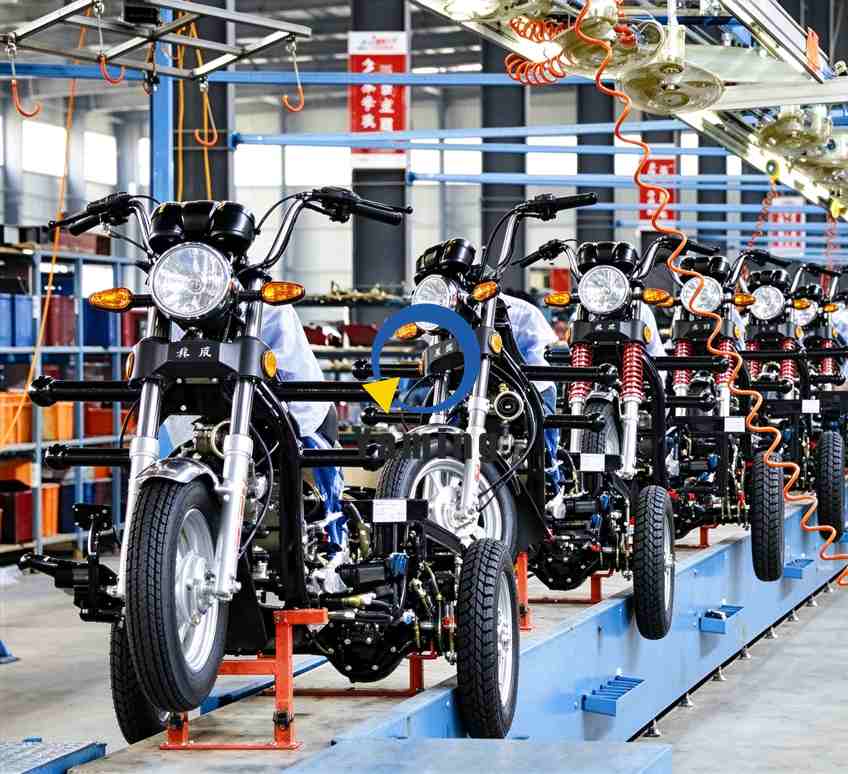
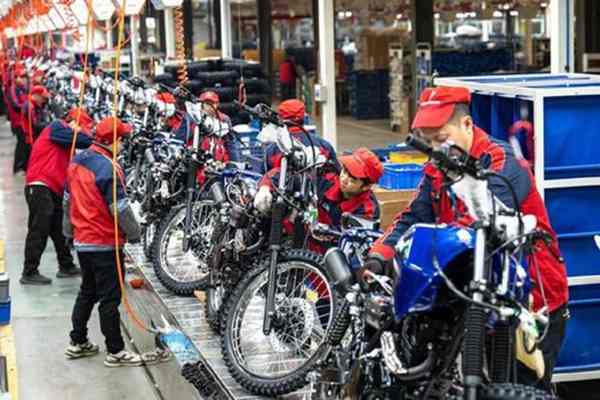
+86 135-2083-2251The image depicts a straight‑line continuous‑flow assembly system built around a central conveyor backbone—most likely a slat chain or roller conveyor designed to carry engine cradles or sub‑assembly pallets from line start to line end. This is a classic single‑piece flow configuration, where each unit progresses through sequential workstations without batching or buffer accumulation between stages.
Workstations are arranged in a linear, bilateral layout with operators facing the conveyor centerline. This follows established ergonomic principles: tools, fasteners, and component bins sit within the normal reach envelope, minimizing operator movement and repetitive strain. The pitch between stations—visually estimated at 1.5 to 2 meters—directly correlates to takt time calculations. For a single‑shift operation targeting 300 units per day, the line would run at approximately 96 seconds per unit, with each station engineered to complete its assigned work content within that window.
The foreground shows operators performing precision assembly at what appears to be the powertrain marriage zone—the critical stage where the engine, transmission, and front suspension are mechanically joined to the frame. Key process controls include:
Further down the line, partially completed motorcycles with body panels already fitted indicate that mid‑line stations handle cosmetic assembly and electrical integration. Process characteristics include:
While not fully visible in the image, standard motorcycle assembly terminates with:
The simultaneous presence of multiple motorcycle colors—blue and black units visible on the same line—demonstrates mixed‑model production capability. This requires:
The blue component totes visible at the right of the image represent lean logistics in practice. Standardized container footprints—typically 600×400 mm or 530×350 mm—enable timed delivery cycles by “water spider” material handlers. This maintains near‑zero inventory at the point of use while keeping the line fed through a pull‑based replenishment system.
The assembly line functions as a quality containment system, not merely a throughput mechanism. Critical stations incorporate:
Contemporary motorcycle assembly is evolving toward digital integration and sustainable manufacturing. Digital twin platforms allow virtual collision detection and cycle‑time optimization before physical line commissioning. Collaborative robots increasingly handle tire mounting, battery installation, and other high‑effort or precision‑critical tasks. Meanwhile, aqueous coating systems and exhaust extraction at final stations address tightening environmental compliance.
If you have any questions or needs about the automated assembly line, please contact us via email: [email protected]