Welcome to Yaming Technology
Production Lines for Automobiles, Motorcycles & Tricycles Email:[email protected]

Quotation Hotline
+86 135-2083-2251Welcome to Yaming Technology
Production Lines for Automobiles, Motorcycles & Tricycles Email:[email protected]
Quotation Hotline
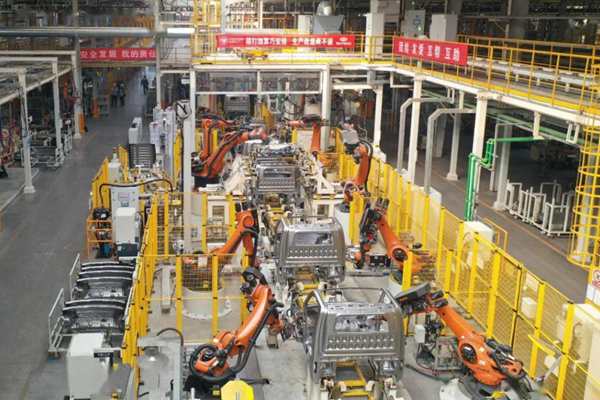
+86 135-2083-2251Contemporary truck assembly lines generally adopt modular island layout design, breaking the linear constraints of traditional assembly lines. Taking body welding as an example, sub-assemblies such as the top cover, front wall, side wall, and doors are completed by robot clusters in an independent “assembly island” and then accurately transferred to the assembly island through the aerial EMS (Electric Monorail Transport System) for assembly. This architecture makes the production line highly flexible and can be compatible with the mixed-line production of more than 600 different vehicle models, realizing seamless switching between pure trams, hybrid cars, and fuel vehicles.
The main body of the assembly line usually adopts a “U”-shaped or “E”-shaped layout, and an AGV (Automatic Guided Transport Vehicle) constitutes a flexible conveying system. Different from traditional fixed chain lines, AGV cars can independently navigate and accurately park according to production instructions, and the station spacing and beat time can be dynamically adjusted. In advanced factories such as Dongfeng Commercial Vehicles, more than 200 AGVs work together with robots, and an average of one light truck goes off the production line every 150 seconds .
Chassis assembly is the core section of truck assembly. After the frame is put on line through the aerial suspension conveyor system (EMS), the modular assembly of the front axle, rear axle, drive shaft, and suspension systems is completed in turn. The key connection points use electric torque fixing tools, the torque value is uploaded to the MES system in real time, and the over-tolerance alarm is automatically issued to ensure the reliability of the chassis assembly. The powertrain (engine, gearbox) is connected in the air through an intelligent lifting system, and the positioning accuracy is controlled within ±0.5mm .
Automatic tire assembly is one of the technical difficulties. Commercial vehicle tires often exceed 1200mm in diameter and weigh more than 100kg. Traditional manual work is extremely intensive. The advanced production line introduces an AI+3D visual guidance system. The robotic arm dynamically tracks the body as it moves with the sled, automatically identifies the wheel hub position and tire pattern direction, completes the full process automation of grabbing, positioning, and tightening, and builds the world’s first fully automatic accompanying assembly line for commercial vehicles .
The cab interior decoration line adopts the hugging conveying and robot collaborative mode. As the core module, the instrument desk is transported by the AGV to the workstation, the 3D vision system guides the glue coating robot to accurately apply glue according to the body posture, and then the assembly robot completes the grasping and installation to ensure the tightness and safety of the cockpit.
Glass assembly uses vacuum cups and automatic gluing technology to replace traditional manual gluing and eliminate hidden dangers of rain leakage .
The “nerve center” of modern assembly lines is the MES (Manufacturing Execution System) and the Industrial Internet platform that run through the entire process. Each workstation is equipped with a visual terminal to display the assembly list, process parameters, and quality traceability code in real time; the large-screen system refreshes the production status every 30 seconds, realizing full-link digital control from material warehousing to vehicle off-line .
At the logistics level, the intelligent three-dimensional library realizes “storage and sorting”. AGVs and AMR (autonomous mobile robots) accurately deliver according to SPS (picking by vehicle) mode, and the centralized allocation rate of parts reaches 95%, completely changing the traditional model of “people looking for materials”. In the quality control process, more than 20 inspection points are set up at key workstations. The final inspection uses a three-dimensional scanner to compare the entire vehicle with the design model to identify assembly errors exceeding 2mm ].
Currently, truck assembly lines are evolving in the direction of higher flexibility and deeper intelligence. Digital twin technology enables real-time mapping of physical production lines and virtual models, supporting process rehearsal and bottleneck optimization;5G+ edge computing reduces equipment collaboration latency to milliseconds; new technologies such as skateboard chassis and CTC (Battery Chassis Integration) have given birth to a dedicated production line for VAN vehicles.
In the dimension of green manufacturing, the application of photovoltaic power supply, waste heat recovery, and water-based paint processes has enabled the factory to meet the green benchmark standard.
From stamping steel plates to driving out of vehicles, a truck assembly line embodies the integration of materials science, robotics, industrial software and systems engineering. It is not only a carrier of production capacity, but also a microcosm of the transformation of the manufacturing industry to intelligence and service.
If you have any questions or needs about the automated assembly line, please contact us via email: [email protected]