1. Overview
The final assembly manufacturing of electric vehicles is a systematic engineering process that integrates thousands of components—such as battery packs, electric drive systems, body structures, chassis, interior trims, and high- and low-voltage electrical components—into a complete vehicle according to strict production takts. Compared with traditional internal combustion engine (ICE) vehicle assembly lines, the most significant difference of an Electric vehicle assembly line lies in two aspects: on one hand, a large number of assembly stations for complex mechanical components such as engines, gearboxes, fuel lines, and exhaust systems are eliminated; on the other hand, new core process stages have emerged, including battery pack hoisting, electric drive system marriage, high- and low-voltage wiring harness connections, vehicle software flashing, and charging tests.
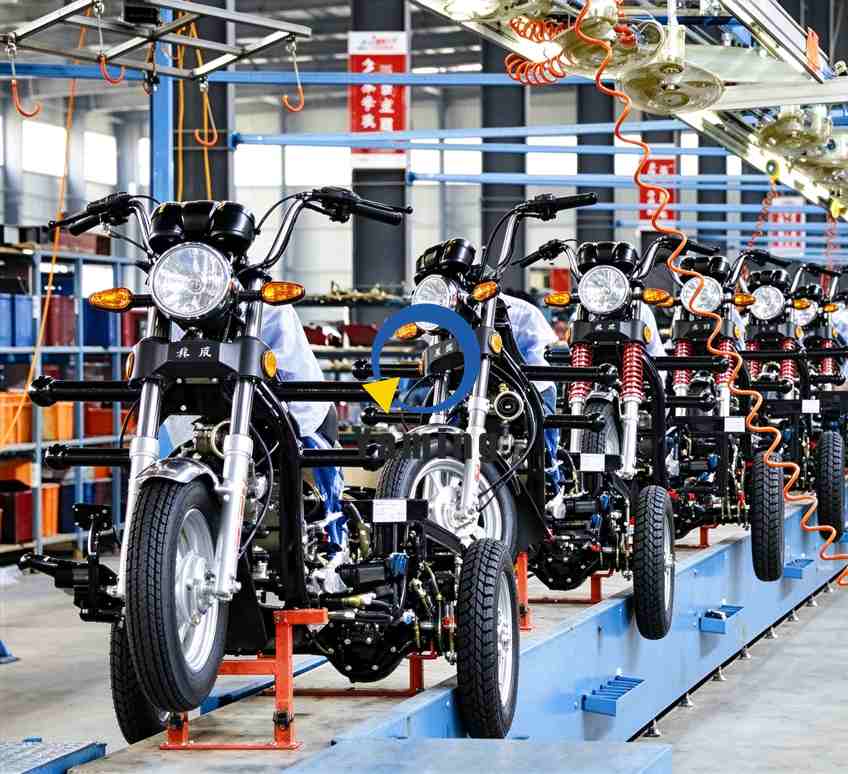
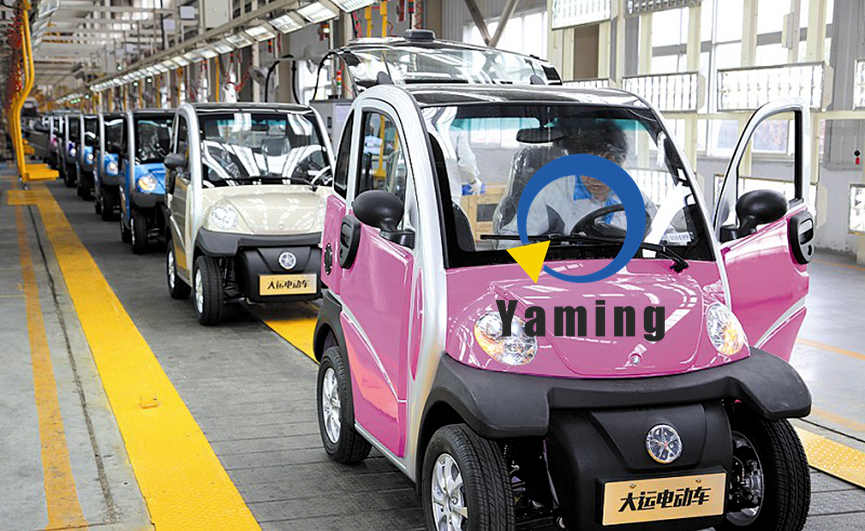
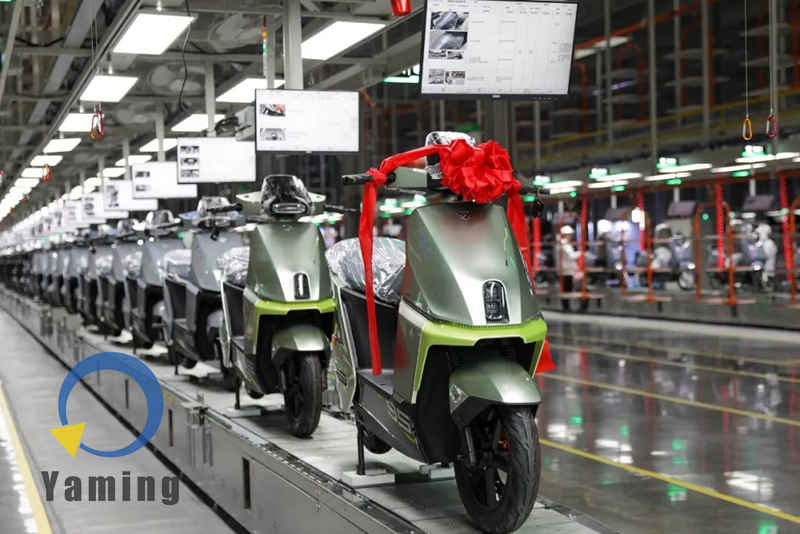
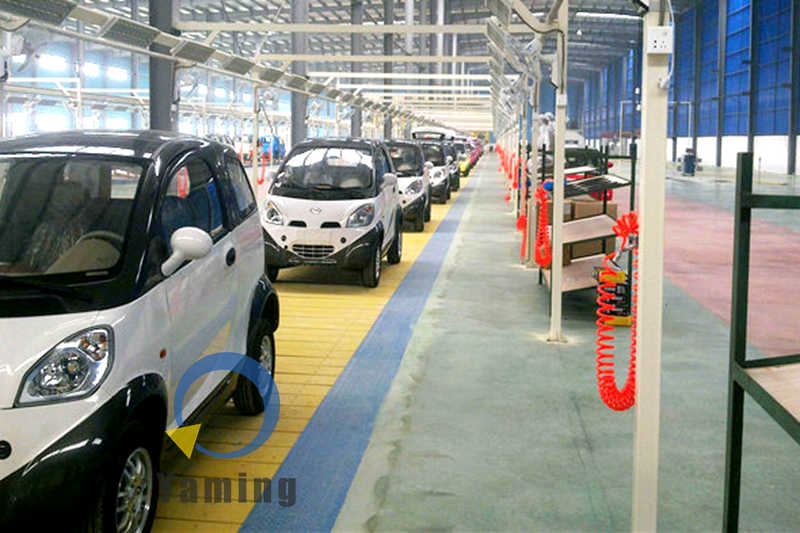
The Electric vehicle assembly line adopts a dual-layer layout architecture of “ground mainline conveyor + overhead material distribution.” The ground-level component is a ground tow chain conveyor system (floor friction/plate-type drag chain), which carries the Body-in-White (BIW) or chassis traveling fixtures, passing through each assembly station sequentially according to the production takt. The overhead component is a suspended material conveyor line arranged along both sides of the mainline, which delivers large parts or sub-assemblies—such as battery packs, seats, doors, and bumpers—to the corresponding assembly stations in fixed quantities and at precise times, achieving synchronous flow of materials and the vehicle body.
According to the EV assembly process sequence, the entire Electric vehicle assembly line is typically divided into the following sections: the body interior assembly section (including instrument panels, wiring harnesses, carpets, seats, etc.), the chassis and battery pack marriage section (including front/rear axles, electric drive units, battery pack hoisting, etc.), the complete vehicle drop and peripheral assembly section (including tires, front/rear bumpers, charging ports, coolant and refrigerant filling, etc.), and the end-of-line testing section (including headlight adjustment, four-wheel alignment, EV electrical inspection, and charging tests, etc.). The ground tow chain serves as the main carrier of the Electric vehicle assembly line, connecting all the aforementioned process sections; while the overhead line acts as an “overhead artery,” accurately delivering various materials to the line-side, collaboratively forming a highly flexible and high-takt EV assembly solution.
2. Details
- Ground Tow Chain Mainline Conveyor System: The ground level of the Electric vehicle assembly line adopts a pallet-free ground tow chain structure, where the drive unit powers the chain to move, and traveling fixture trolleys carry the body or chassis. The line body features variable-frequency stepless speed regulation, allowing it to switch between continuous operation and intermittent stepping modes based on production requirements, thereby meeting the flexibility needs of multi-model mixed-flow production. In front of critical stations such as tire assembly, the ground tow chain can be designed with an elevation ramp section (e.g., raised by 200–400 mm at a 2° gradient) to lift the vehicle body to an ergonomic height, reducing operator physical strain.
- Side Overhead Material Conveyor Line: An overhead conveyor is installed above both sides of the Electric vehicle assembly line mainline, consisting of four major modules: the track system, drive unit, lifting fixtures/load bars, and control system. This system makes full use of the upper factory space, leaving the ground clear for operators and equipment, thus making the line-side logistics channels more organized. The overhead conveyor speed is typically adjustable from 0.5 to 15 m/min, with a single-point load capacity ranging from a few kilograms to several tons, enabling stable transportation of heavy sub-assemblies such as battery packs, seats, and doors. Modern intelligent overhead lines on the Electric vehicle assembly line can also be integrated with RFID or vision recognition systems to achieve intelligent material tracking and error-proofing.
- Workstation Operations and Ergonomics: Operating stations are arranged along both sides of the Electric vehicle assembly line ground tow chain. Workers use pneumatic/electric torque-controlled tools to complete fastening operations, with orange spiral air hoses and cables supplied to the stations nearby via a top modular truss. For heavy-part assembly such as battery pack hoisting and electric drive marriage, KBK light crane rail systems or assistive manipulators are usually deployed to reduce manual labor load.
- Distributed Control and Status Monitoring: Three-color signal towers are installed above each workstation of the Electric vehicle assembly line. Relying on a PLC + distributed I/O control network, real-time monitoring of line status, automatic takt control, and rapid fault response are achieved. Electric torque-controlled tools are used at critical fastening points, and torque data for critical safety components is collected and uploaded in real-time to ensure assembly quality traceability.
- Flexible Expansion Capability: Both the ground tow chain and the overhead line of the Electric vehicle assembly line adopt a modular design. If adjustments to model mix ratios, addition of workstations, or process route changes are needed in the future, quick adaptation can be achieved by adjusting trolley support points, extending the overhead track, or reconfiguring lifting fixtures, thereby protecting the customer’s initial investment.
3. Parameters
(Note: The following parameters are reference values based on typical industrial standards for similar Electric vehicle assembly line (new energy vehicle final assembly ground tow chain lines and overhead conveyor lines). Specific values are subject to actual project process planning and equipment technical agreements.)
| Parameter Category | Item | Reference Specification / Description |
|---|---|---|
| Ground Tow Chain Mainline | Load Capacity | 0.6 t – 3.5 t (total chassis weight, calculated at equal intervals) |
| Station Length | 6000 mm | |
| Effective Line Length | Approx. 66 m (extendable according to process planning) | |
| Operating Speed | 2.0 – 8.0 m/min (variable frequency stepless speed regulation, continuous/stepping optional) | |
| Production Takt | 15 – 30 min/unit (depending on the complexity of the specific EV model’s process) | |
| Elevation Ramp | Raised 200 – 400 mm, 2° gradient | |
| Overhead Material Line | Conveying Speed | 0.5 – 15 m/min (adjustable) |
| Single-point Load | Several kg – several tons (adaptable for battery packs/seats/doors, etc.) | |
| Drive Method | Chain drive or friction drive | |
| Track Material | High-strength steel / Aluminum alloy | |
| Electrical & Control | Control Core | PLC + Distributed I/O + HMI |
| Identification System | Optional RFID or vision recognition | |
| Safety Protection | Broken chain/jammed chain detection, overload alarm, interlocked with main drive |
Through the stable carrying and stepping conveyance of the ground tow chain, combined with the precise overhead distribution of the suspended line, the entire Electric vehicle assembly line creates a highly efficient production scenario where ground assembly and overhead logistics do not interfere with each other and information flows seamlessly. This fully meets the comprehensive demands of new energy vehicle manufacturers for multi-model mixed-flow production, high assembly quality, and controllable manufacturing costs.