Welcome to Yaming Technology
Production Lines for Automobiles, Motorcycles & Tricycles Email:[email protected]

Quotation Hotline
+86 135-2083-2251Welcome to Yaming Technology
Production Lines for Automobiles, Motorcycles & Tricycles Email:[email protected]
Quotation Hotline
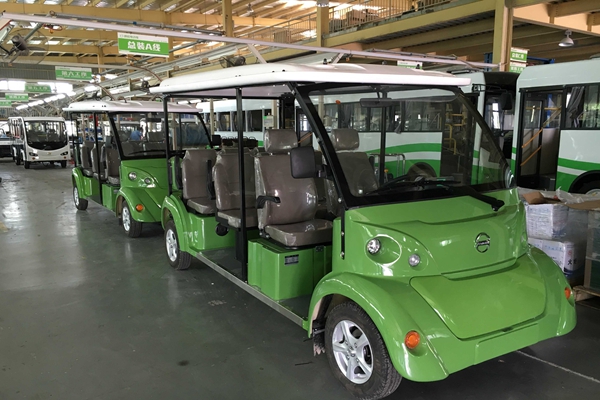
+86 135-2083-2251The image presents a specialized automotive assembly line dedicated to the production of low-speed electric vehicles, specifically open-air sightseeing shuttles and resort transport vehicles. Unlike conventional automotive plants designed for high-volume passenger car output, this facility exemplifies a flexible, medium-volume production system optimized for product variety and assembly accessibility. The assembly line architecture visible in the photograph reflects a deliberate departure from the densely automated environments of major OEM plants, favoring instead a layout that maximizes human operator engagement with the vehicle structure.
The assembly line adopts a linear, side-by-side station configuration rather than the overhead conveyor suspension typical of high-volume automotive plants. Vehicles are positioned on a flat, polished concrete floor surface, allowing for ground-level assembly operations throughout the entire production sequence. This floor-based approach is a calculated engineering decision rooted in the product characteristics. These low-speed vehicles feature exposed chassis frames, open body structures, and minimal underbody enclosures, rendering overhead suspension unnecessary and potentially obstructive for the installation of side panels, seating systems, and electrical components.
The green and white vehicles are arranged in a progressive build sequence, each unit representing a different stage of completion. The foreground vehicle appears nearly finished, with seating installed, body panels fitted, and front fascia assembled, while units further down the line show progressively less completion. This visual progression is the defining characteristic of flow production. Each station adds defined value, and the product moves unidirectionally from raw chassis to finished goods.
The assembly stations are designed around the principle of total accessibility. The absence of fixed enclosures, doors, and roof structures on these open-air vehicles means that operators can approach the assembly from virtually any angle. The seating modules, visible in the foreground vehicle, are installed through wide, unobstructed side apertures. This task would require complex robotic manipulation or specialized fixtures in a conventional passenger car plant. Here, the assembly process leverages the product’s inherent simplicity to reduce tooling complexity and increase manual assembly efficiency.
The overhead structure visible in the facility serves multiple functions. It supports the building’s roof and lighting systems. It likely contains compressed air lines, electrical distribution, and possibly overhead material delivery conveyors. The green signage suspended from this structure, bearing Chinese characters indicating station identifiers or production line names, demonstrates the integration of visual management systems into the facility architecture. This is a hallmark of lean manufacturing environments.
The production sequence for these electric sightseeing vehicles follows a logical assembly hierarchy determined by component interdependency and physical access constraints. The process typically begins with chassis frame preparation and powertrain installation, including electric motor, controller, and battery pack mounting. These operations are performed on the bare frame before body panels obscure access points. Subsequent stations progress through body panel attachment, electrical system routing, interior component installation, and final quality verification.
The takt time, representing the production rhythm matching customer demand, is necessarily longer than in high-volume automotive plants. This reflects the lower production volumes and higher product variety. Where a mass-market sedan plant might achieve a 60-second takt time, this facility likely operates on a takt time of several minutes or more, allowing operators to perform multiple assembly tasks at a single station before the line advances. This extended cycle time accommodates the greater manual content and reduced automation typical of specialty vehicle manufacturing.
The image reveals critical aspects of the material supply strategy. Cardboard boxes and component packaging are visible adjacent to the assembly line, indicating a just-in-time or sequenced parts delivery approach where components arrive at the point of use shortly before installation. This minimizes work-in-process inventory and reduces the facility’s footprint requirements. For a low-volume operation, this proximity-based logistics system is more cost-effective than the automated guided vehicle networks and sophisticated warehouse management systems employed by major automotive manufacturers.
The seating modules, body panels, and electrical components likely arrive at the facility as pre-assembled subsystems, reducing the number of individual parts that must be installed on the main line. This modular assembly strategy, common in low-volume and specialty vehicle production, shifts complexity to tier-one suppliers and simplifies the final assembly process.
The assembly line’s reliance on manual operations places significant emphasis on operator skill and in-process quality verification. Unlike automated plants where robotic precision compensates for process variation, this facility’s quality outcomes depend heavily on operator training, standardized work instructions, and visual inspection protocols. The open structure of the vehicles actually facilitates quality inspection. Inspectors can visually verify electrical routing, fastener installation, and component alignment without the disassembly or specialized access equipment required for enclosed passenger vehicles.
The assembly environment also reflects ergonomic considerations adapted to the product. The low vehicle height and wide door openings eliminate the need for elevated platforms or overhead reach that characterize conventional automotive assembly. Operators work at natural standing heights, reducing physical strain and enabling sustained productivity over extended shifts.
| Characteristic | This Facility | Conventional Automotive Plant |
|---|---|---|
| Conveyor type | Floor-based, no overhead suspension | Overhead skillet or slat conveyor |
| Vehicle access | Open structure, 360-degree access | Enclosed body, limited access points |
| Automation level | Low to moderate, human-centric | High, extensive robotic integration |
| Takt time | Several minutes per unit | 60-90 seconds per unit |
| Production volume | Medium, high variety | High volume, limited variety |
| Material logistics | Line-side packaging, just-in-time | AGV networks, automated warehouses |
| Assembly strategy | Modular sub-systems from suppliers | In-house component fabrication |
| Quality approach | Operator-dependent, visual inspection | Automated sensing, robotic verification |
This sightseeing vehicle assembly line represents a distinct manufacturing paradigm. It prioritizes flexibility, accessibility, and human operator integration over the automation intensity of mass-market automotive production. The linear floor-based layout, extended takt times, and modular assembly approach collectively define a production system optimized for medium-volume, high-variety electric vehicle manufacturing.
While the scale and automation level differ from conventional automotive plants, the underlying engineering principles remain consistent. Sequential value addition, unidirectional flow, in-process quality control, and ergonomic workstation design apply across both contexts. In an evolving automotive landscape increasingly populated by electric vehicles and specialty transport solutions, this type of adaptable assembly line demonstrates how manufacturing engineering principles scale across product categories and production volumes, delivering efficient, quality-assured output tailored to niche market requirements.