Motorcycle Industry Classification
The motorcycle industry is divided by engine displacement and application, with the combination of displacement and purpose being the most commonly used classification.
By displacement: Light motorcycles, 50cc to 125cc, the mainstay of urban commuting; Medium motorcycles, 150cc to 400cc, balancing commuting and leisure; Heavy motorcycles, 500cc and above, primarily for cruising, touring, and sport riding.
By application: Street bikes, suitable for daily riding, agile handling; Sport bikes, pursuing speed and handling performance; Cruisers, low seat height, long wheelbase, ideal for comfortable long-distance riding; Adventure bikes, combining on-road and off-road capabilities, suitable for exploration travel; Scooters, automatic transmission, flat floor design, the first choice for city commuting; Dirt bikes, designed specifically for off-road terrain, long suspension travel; Three-wheeled motorcycles, sidecars or reverse trikes, for special cargo or passenger purposes; Electric motorcycles, powered by batteries, developing rapidly in recent years.
Motorcycle Final Assembly Line
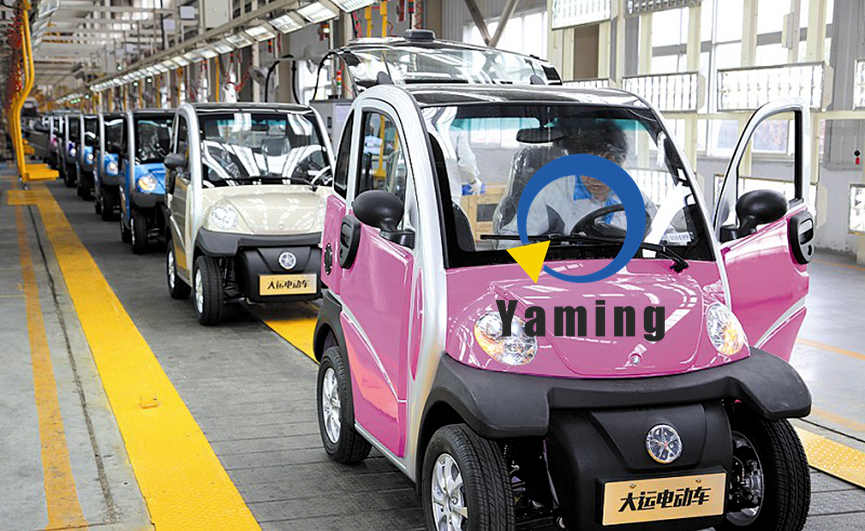
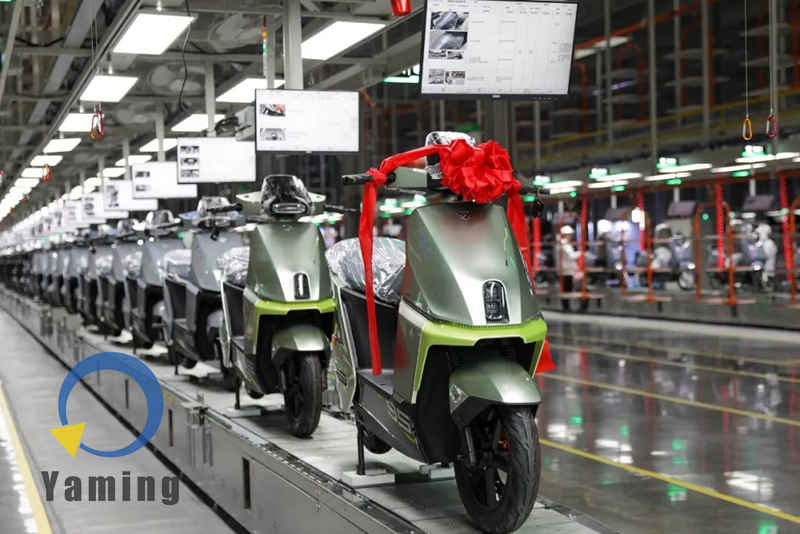
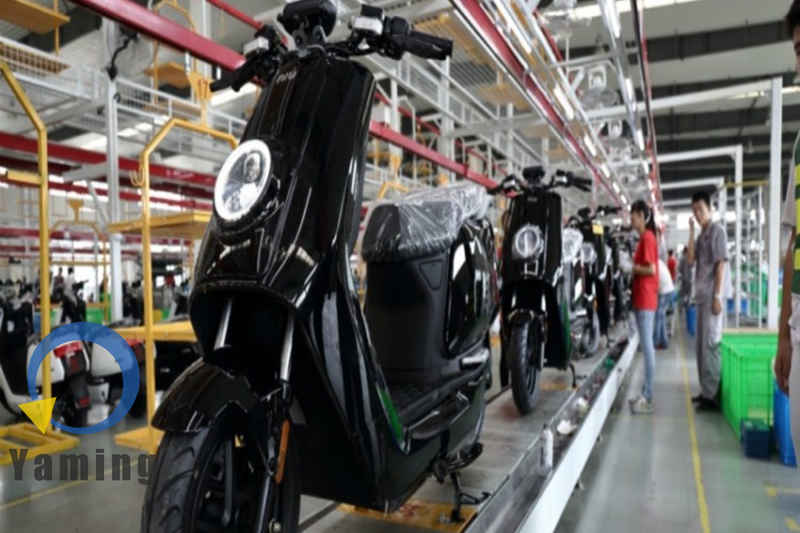
The modern motorcycle final assembly line has evolved from the traditional fixed-station assembly model into a flexible intelligent manufacturing system integrating conveying, assembly, inspection, and informatization.
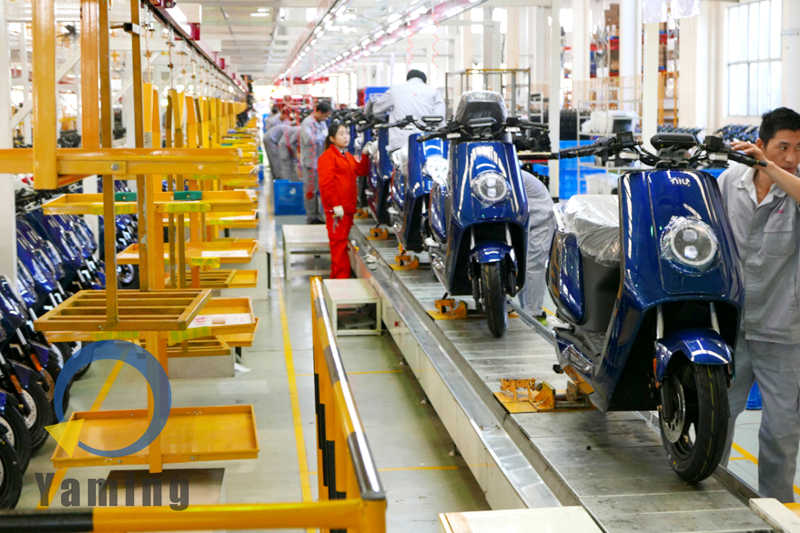
A contemporary motorcycle assembly line consists of four core subsystems: the conveying system, the process equipment system, the inspection system, and the control system. The conveying system, primarily based on a plate chain conveyor or overhead chain conveyor, carries the frame through the entire process from loading, pre-assembly, final assembly to offloading. The process equipment system includes automatic tightening devices, pressing equipment, filling equipment, vision-guided systems, and more. The inspection system handles four-wheel alignment (for three-wheeled motorcycles), braking performance testing, lighting inspection, emission testing, etc. The control system is centrally managed by PLC plus an MES system, enabling real-time monitoring and analysis of production data. The frame enters the assembly line from the paint shop, sequentially completing engine or motor installation, front and rear suspension assembly, wheel installation, brake system installation, fuel tank and fuel supply system assembly, electrical harness routing, exterior part installation (fairings, seat, etc.), and finally undergoing complete vehicle dynamic testing and road test.
In terms of production cycle time, mainstream motorcycle assembly lines typically achieve 45 to 90 seconds per unit, while high-end model lines may reach 120 to 180 seconds per unit. For automation rate, joint venture and premium brand production lines can reach 60% to 80%. For manpower, a medium-scale line with an annual output of 100,000 units can be operated by 50 to 80 people. In energy consumption, fully automated lines save about 10% to 15% compared to semi-automated ones. Straight plate chain lines are suitable for high-volume general models, while circular lines or friction drive lines are suitable for multi-model, small-batch flexible production.
Modularity and rapid changeover capability are key technologies for handling motorcycle model diversity (street bikes, sport bikes, cruisers, ADV bikes, etc., produced on the same line). Modular design allows flexible adjustment of workstation quantity and configuration, enabling different models to be produced via quick die changes and program switching. Same-platform model changeover time typically does not exceed 15 minutes, while cross-platform changeover does not exceed 45 minutes. In automatic die-change systems, fixture quick-change mechanisms can complete model change within 5 minutes. Different vehicle types have distinct process requirements: sport bikes require precise frame geometry positioning and high-strength bolt tightening torque control; cruisers need to ensure engine and drivetrain concentricity; electric motorcycles require high-voltage safety detection and insulation testing for the battery pack.
For information traceability and precision assembly, full MES control ensures that all production data can be traced, facilitating quality management and process optimization. The critical station pass rate on high-end intelligent lines can reach over 99.8%. Precision assembly equipment includes servo presses (pressure control accuracy ±1%) for installing bearings and bushings, automatic brake fluid filling machines (liquid volume ±1 ml), multi-axis automatic tightening machines (torque accuracy ±3%), robotic glue dispensing and vision inspection systems, and online dynamic balancing inspection equipment. The final assembly line itself typically adopts a plate chain conveyor or friction wheel conveyor, with adjustable line speed, and stations are equipped with electric or pneumatic tools, material call systems, andandon systems.
Typical Parameters of the Motorcycle Final Assembly Plate Chain Conveyor
The motorcycle final assembly line generally adopts a plate chain conveyor structure, composed of steel guide rails, steel plates, and specialized roller chains. Below are common reference configurations in the industry:
Basic Line Parameters
- Line length: Standard reference 40 meters, customizable from 30 to 120 meters according to production capacity.
- Line width: 500–600 mm, chain plate width 180 mm.
- Working height: 450 mm (±10 mm adjustable).
- Station pitch: 1.5–2.5 meters per station; frame positioning fixtures are configured at intervals of 1.8–2.8 meters along the line.
- Number of stations: 16–20 opposed stations (for a standard 40-meter line).
Chain Plate and Conveying System
- Chain plate dimensions: 400 mm × 180 mm × 2 mm (fixture chain plates use 3 mm thick cold-rolled steel).
- Chain type: Special single-side curved-plate roller bearing chain with 80 mm pitch; one set of guide wheels every 800 mm.
- Chain roller diameter: 32 mm; upper rail uses 35×50×5 angle iron, lower rail uses 45×45×5 angle iron.
- Support frame: Made of 40×60×3 square steel tube, support spacing 800 mm.
- Surface treatment: Spray painting for the line body, galvanized anti-rust treatment for chain plates.
Drive and Speed Control
- Drive: Variable-frequency motor with cycloidal pinwheel reducer, typical power 2.2–4.0 kW.
- Line speed: 0.5–8 m/min adjustable (commonly 0.8–5 m/min), stepless variable-frequency speed regulation.
- Operation mode: Continuous running / intermittent indexing (paced) operation, selectable; cycle time set by PLC.
Auxiliary Configurations
- Each station equipped with: 220V power socket, 6-point galvanized air pipe quick coupling, tool hanger, parts bin, material call button.
- Air supply joints on both sides of the line at each station; power sockets arranged bilaterally.
- For lines with overhead canopy: two LED lights and one industrial fan per station.
- Four to five emergency stop buttons distributed at the head, middle, tail, and critical stations.
- Single-point load capacity: 150–300 kg, suitable for motorcycle component conveying.
Production Efficiency
- Average improvement of 40%–60% in assembly efficiency compared to traditional fixed-station assembly.
- Rhythm-based production requires that the process operation time at each station be roughly balanced to maximize overall line efficiency.
Key Design Logic of the Plate Chain Conveyor: The chain plates move in a continuous loop together with the chain. The motorcycle frame is fixed onto traveling pallets via dedicated fixtures. The workpiece moves along the line, and operators at each station perform their assigned assembly actions according to the takt time. Sensors cooperate with the PLC to ensure precise stopping positions, achieving paced production where “the vehicle moves while the worker stays.” For heavy motorcycles, a double-layer plate chain or a composite line with powered rollers can be adopted to accommodate greater weight.