1. Overview
The three-wheeler production line, also known as three-wheeler assembly line, is the core terminal equipment for the complete vehicle manufacturing of three-wheeled motor vehicles. It assembles hundreds of components including frames, powertrains, rear axles, suspensions, cargo boxes, instruments and wiring harnesses into finished three-wheelers.
The current three-wheeler market features obvious long-tail characteristics. Segmented categories keep expanding, including fuel-powered three-wheelers, electric cargo three-wheelers, electric mobility three-wheelers and custom export three-wheeler models. Different models differ greatly in wheelbase, track width, rated load capacity, power type and assembly tact time, which raises higher requirements for the flexible compatibility of the three-wheeler production line.
Conventional rigid three-wheeler assembly lines are only suitable for single-power and single-spec vehicle production. Model changeover requires extensive disassembly and reassembly of tooling, featuring long modification cycles and high investment costs, which fails to meet multi-variety, small-batch long-tail orders. This three-wheeler production line adopts a combined solution of overhead pipe truss and floor plate-chain tooling platform. Developed specially for mixed-model production, it enables mixed assembly of electric three-wheelers and fuel three-wheelers. It is widely applied in new workshop construction and flexible upgrading of old production lines for three-wheeler OEMs. The line covers compact mobility three-wheelers up to heavy-load cargo three-wheelers. It helps vehicle manufacturers reduce modification costs for new model rollout, shorten product iteration cycles, and fit the long-tail production mode with parallel manufacturing of multiple three-wheeler variants.
2. Process Composition
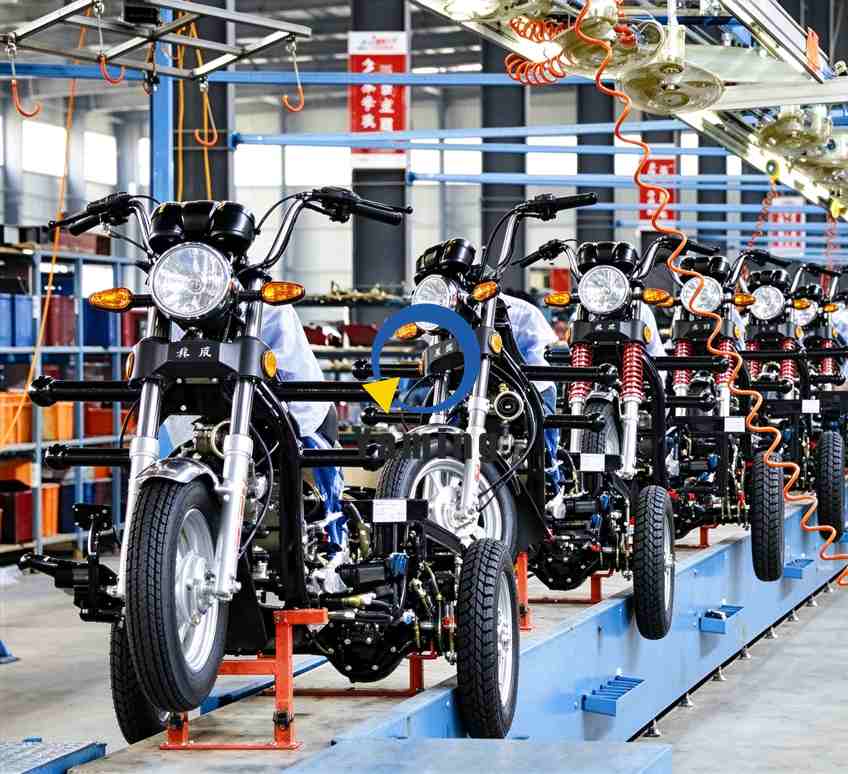
This three-wheeler production line mainly consists of floor plate-chain main conveyor (three-wheeler-specific load-bearing tooling stands shown in the picture), overhead pipe truss and station auxiliary systems, with integrated mechanical, electrical and pneumatic design.
Floor plate-chain main conveyor: The line adopts plate-chain conveying structure equipped with quick-change three-wheeler-specific tooling stands. The tooling stands are fitted with model positioning locking mechanisms and run continuously along the plate-chain track. It supports fixed-position workstation stop, product buffering and fault isolation to transfer painted frames to each assembly station. Positioning fulcrums on tooling can be rapidly switched to match frame reference datums of various three-wheeler models and realize mixed-flow production of multiple three-wheeler types. The plate-chain plus independent tooling stand structure stably supports complete vehicles and allows operators to assemble engines/motors, rear axles, brakes, cargo boxes and wiring harnesses on both sides of the frame. It serves as the core carrier for flexible mixed production of fuel and electric three-wheelers on this three-wheeler assembly line.
Overhead pipe truss: The blue truss above the workshop integrates compressed air pipelines, power supply circuits and workstation lighting. The orange coiled retractable air hoses in the image supply air for pneumatic tightening tools at each workstation. Pipelines are laid synchronously along the production line for centralized air supply, meeting the high-volume bolt-tightening operations in three-wheeler assembly. Neat on-site piping simplifies maintenance.
Station auxiliary systems: The line is equipped with workstation lighting, quick pneumatic connectors and signal acquisition modules. The whole line is centrally controlled by PLC. Each tooling stand carries an RFID tag to read vehicle model codes at every station and automatically trigger corresponding workstation programs. The mistake-proofing system verifies component part numbers to prevent misassembly between fuel and electric power parts during mixed production, ensuring stable operation of the three-wheeler production line.
Main process flow: Painted frame loading onto tooling stand → plate-chain conveyance → handlebar & instrument wiring harness assembly → powertrain (engine / drive motor) and rear axle marriage → suspension & brake system assembly → fuel tank / battery pack installation → cargo box assembly → tire mounting → pipeline & wiring inspection → complete vehicle performance commissioning → offline inspection → final vehicle audit. Tact time of each station can be independently adjusted. Buffer sections are arranged at bottleneck stations to satisfy production scheduling requirements for multiple long-tail three-wheeler models, supporting mixed-flow switching between fuel three-wheelers and electric three-wheelers.
3. Customizable Parameters
The complete three-wheeler production line supports customization of core parameters according to OEM production capacity and three-wheeler model scope, adapting to diversified manufacturing demands of long-tail three-wheeler models:
- Production tact time: Customizable range of 30~180 JPH (jobs per hour). Selected based on plant footprint and order volume; plate-chain length is adjusted to match production capacity for different scales of three-wheeler assembly line planning.
- Compatible vehicle specifications: Fits three-wheeler wheelbase 1200~2400 mm. Rated load capacity of tooling stands optional at 300 kg, 500 kg, 800 kg. Support fulcrums and limit structures are customized per three-wheeler frame locating data. Mixed production of fuel three-wheelers and electric three-wheelers is supported to cover cargo and mobility three-wheeler types in the long-tail market.
- Conveyor system parameters: Plate-chain running speed adjustable from 0.3~5 m/min. RFID-based tooling identification, storage capacity for ≥80 three-wheeler model recipes. Plate chain and rack material are designed in accordance with workshop load requirements to ensure long-term reliable operation of the three-wheeler production line.
- Workstation & control: Number of stations and tooling stand configuration can be adjusted on demand. Control PLC options include Siemens / Mitsubishi. The system supports connection to factory MES systems for production data uploading, workstation status monitoring and fault alarming, enabling digital control over the whole three-wheeler assembly line.
- Environmental adaptation: Equipment coating, sealing and electrical protection class can be adjusted based on workshop temperature, humidity and dust conditions. Tooling marking and safety warning signs are customized following client specifications.
The core advantage of this three-wheeler production line lies in its flexibility. When adding new long-tail three-wheeler models after line commissioning, in most cases only tooling positioning support blocks need replacement and control programs updated, without large-scale steel structure reconstruction. It significantly cuts investment for launching new three-wheeler models and enables flexible mixed production of fuel and electric three-wheelers.