Welcome to Yaming Technology
Production Lines for Automobiles, Motorcycles & Tricycles Email:[email protected]

Quotation Hotline
+86 135-2083-2251Welcome to Yaming Technology
Production Lines for Automobiles, Motorcycles & Tricycles Email:[email protected]
Quotation Hotline
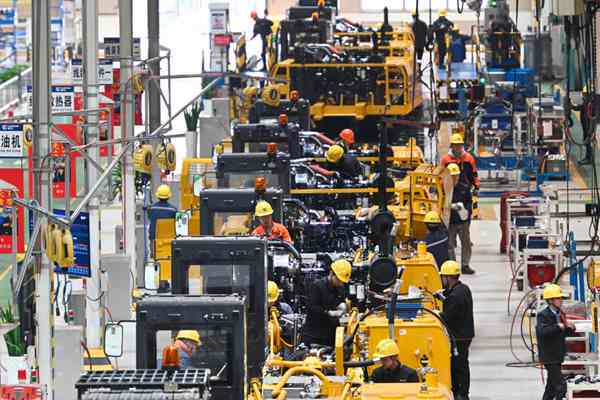
+86 135-2083-2251In the field of modern construction machinery manufacturing, excavator assembly lines are the core carrier for achieving efficient and standardized production. The assembly line shown in the figure presents a typical production model that combines island-style segmented assembly with continuous flow of the main line. The entire production line takes the yellow body frame as the visual axis, and multiple excavator chassis are arranged in turn along the track, forming a highly orderly production rhythm.
It can be seen from the picture that the assembly line adopts a flexible segmented layout. The entire assembly line is not a single continuous conveyor belt. Instead, it uses the excavator chassis as the carrier and realizes step-by-step flow between stations through ground rails or AGV carts. The spacing between each station is about 5-8 meters, which just accommodates an excavator chassis and its surrounding working space. The advantage of this layout is that when a certain workstation has a beat delay due to complex operations, subsequent workstations can still operate independently and will not cause the entire line to stagnate. Both sides of the production line are equipped with three-dimensional material suspension systems-including aerial slides, spring balancers and workstation tool racks. The red-marked “oil” supply station and various pneumatic tool hangers can be seen on the left, indicating that this station may involve pre-installation of power systems or hydraulic pipeline connections. On the right side are blue turnover boxes and cable reels, corresponding to the laying of electrical wiring harnesses or assembly of hydraulic components.
The assembly of excavators usually follows the principle of “from bottom to top, from inside to outside, static first and then dynamic.” Combined with the operating status of each station in the picture, it can be inferred that the assembly line roughly covers the following core process sections: Chassis pre-assembly section: Located at the front end of the production line (far away in the picture), it mainly completes the positioning and bolt fastening of structural parts such as lower frames, track tensioner, and slewing bearing bases. At this stage, torque fixed value wrenches are often used to ensure that the pre-tightening force at the chassis connection points meets the design standards. Powertrain integration section: The engine compartment frame can be seen in the middle of the picture and operators are assembling around the power package. The key technologies of this station are the coaxiality calibration of the engine and the hydraulic pump, and the pre-compression control of the shock absorber pad. Any small assembly deviation will be directly transmitted to the vibration index of the whole machine. Hydraulic system pipe layout section: About 60% of excavator failures are related to the hydraulic system, so pipeline assembly is the focus of quality control for the entire production line. It can be seen in the picture that multiple black hydraulic hard pipes are arranged along the direction of the fuselage. The operator needs to follow the order of “hard pipes first, then hoses, first large diameters then small diameters” and use special flaring tools to ensure the accuracy of the sealing surface of the pipe joint. At the same time, the cleanliness of the pipeline is controlled throughout-each interface needs to be flushed and blocked online after assembly. Cab and cover installation section: located at the end of the production line (near end in the picture), mainly completing cab down-installation, wiring harness docking, appearance cover assembly and marking of the whole machine. This stage emphasizes ergonomic verification, including online random inspection of joystick travel, pedal angle, and field of view.
In the picture, workers generally wear yellow helmets and tooling, and some workstations are equipped with torque visualization systems and bar code traceability terminals. These information equipment is linked with the MES system to achieve “one machine, one gear” assembly data archiving. For example, the tightening curve of key bolts, the pressure holding test results of hydraulic lines, and the initial brush-writing records of the engine ECU can all be uploaded in real time through the workstation terminal. In the testing process, the production line may be equipped with online water and pressure testing stations and offline comprehensive debugging islands. The former conducts a pressure maintenance test on the hydraulic system at 1.5 times the rated pressure to check for leakage points; the latter calibrates the response speed and complex action coordination of each actuator component by simulating load operation.
The current excavator assembly line is being upgraded towards two dimensions: modular pre-installation and human-machine collaboration. Some workstations in the picture still rely on a large number of manual operations. In the future, the “supplier pre-installation + complete machine docking” model can be implemented in modules such as power systems and hydraulic valve sets to reduce the number of workstations in the production line by more than 30%. At the same time, for the highly repetitive bolt tightening and wire harness plugging processes, collaborative robots can be introduced to achieve parallel human-machine operations, improving the output efficiency of single station without changing the existing production line layout.
If you have any questions or needs about the automated assembly line, please contact us via email: [email protected]