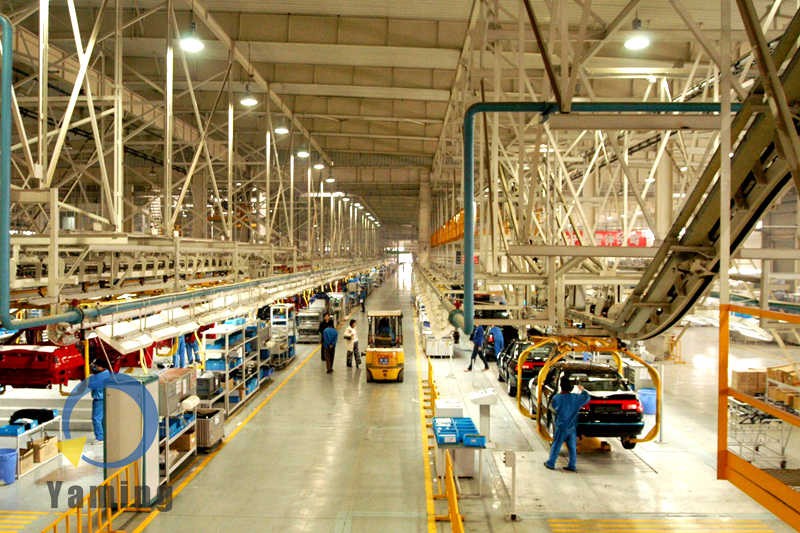
The automotive assembly line consists of a floor conveyor system and an overhead conveyor system. The two systems run in parallel within the same workshop, undertaking different functions.
I. Floor Conveyor System (Floor Tow Chain)
The floor system adopts a floor tow chain. As a core component of the automotive assembly line, the floor tow chain is installed in a ground trench, with the chain circulating along a fixed track. Pallets are fixed to the chain, and the vehicle chassis is placed on the pallet surface, moving forward with the chain. The running speed of the floor tow chain is set according to the station cycle time, and the dwell time at each station is determined by the production takt. Workers stand on both sides of the floor tow chain and complete chassis component assembly while the vehicle body is moving. The floor tow chain has a large load-bearing capacity, suitable for carrying the weight of a complete vehicle body and internal parts. The chain is made of steel, and its surface is treated for a long service life. The driving device of the floor tow chain is located at the end of the line body and consists of a motor, a reducer, and a sprocket. The chain tensioning device is installed at the other end to adjust the chain tension. The track of the floor tow chain is laid below the ground, and its surface is flush with the ground, not affecting the passage of personnel and vehicles.
II. Overhead Conveyor System (Power and Free Conveyor)
The overhead system adopts a power and free conveyor. In the automotive assembly line, the power and free conveyor consists of a suspension track, carrier trolleys, a traction chain, and a driving device. The track is installed below the steel structure of the workshop roof at a certain height from the ground. The carrier trolleys are hung on the track, and the trolleys are connected by the traction chain. The driving device drives the chain to move, and the chain drags the trolleys to run along the track. The characteristic of the power and free conveyor is that it can accumulate trolleys at specific positions. When a station needs to stop operation, the trolley at that position can disengage from the main chain and stay above the station, while other trolleys continue to run along the main track. This design allows each station to be controlled independently, without being affected by the front and rear stations. The power and free conveyor is mainly used to transport body shells or bodies to be assembled, and is also used in welding and painting workshops. In the final assembly workshop, the power and free conveyor is usually used to transport the body from the painting workshop to the final assembly workshop, or to transfer bodies between different sections of the automotive assembly line.
III. Three-dimensional Conveyor Network and Final Assembly Process
The floor tow chain and the power and free conveyor form a three-dimensional conveyor network in the automotive assembly line. The floor tow chain is responsible for main line assembly, and the power and free conveyor is responsible for auxiliary transfer and storage. After the body comes out of the painting workshop, it is transported by the power and free conveyor to the entrance of the final assembly workshop. At the entrance, the body is transferred from the trolley of the power and free conveyor to the pallet of the floor tow chain, and the final assembly process begins. The final assembly process is divided into multiple sections, including interior assembly, chassis assembly, final assembly, and testing. Each section is undertaken by a section of the floor tow chain, and transfer devices connect the sections. When a section fails or needs adjustment, the power and free conveyor can act as a buffer to temporarily store some bodies, avoiding a complete shutdown of the automotive assembly line.
IV. Station Layout of the Automotive Assembly Line
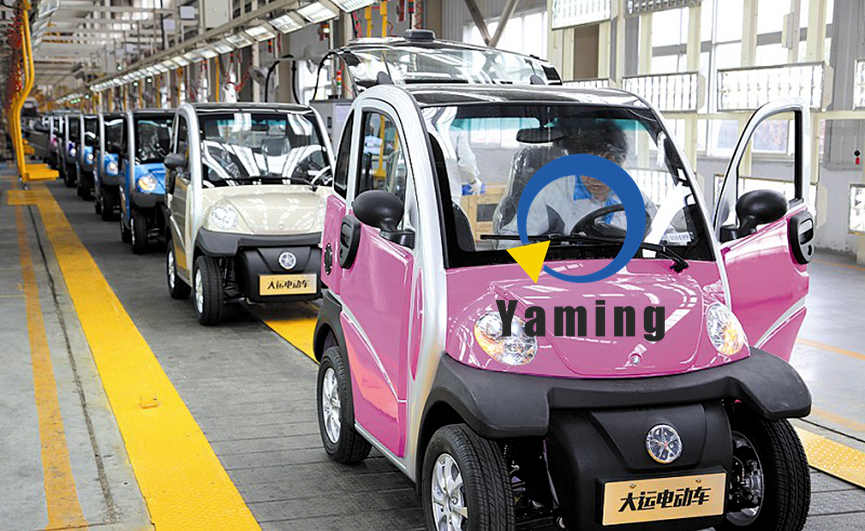
The station layout of the automotive assembly line is arranged according to the assembly sequence. The interior assembly section is located at the front end of the line body. Workers enter the vehicle through the door opening to install instrument panels, seats, interior panels, wiring harnesses, and other components. The chassis assembly section is located in the middle of the line body. Workers install engines, gearboxes, suspensions, fuel tanks, exhaust pipes, and other components under and on both sides of the vehicle body. These components are delivered to the assembly position by independent conveyor lines and docked with the vehicle body through mechanical assist equipment. The final assembly section is located at the rear end of the line body. Workers install external components such as tires, doors, bumpers, and lamps. The testing section is located at the end of the line body, including four-wheel alignment, lighting inspection, brake inspection, rain test, and other items.
V. Station Equipment and Control System
Each station is equipped with tools and equipment. Electric tightening tools are used for bolt connections, and torque values are controlled and recorded by the system. Material racks are located on both sides of the station, storing the parts required for the station. The height and angle of the material racks are designed according to ergonomic requirements. Lighting fixtures are installed above the stations, and the illuminance value complies with national standards. Some stations are equipped with station screens to display work instructions and process parameters.
The control system consists of a PLC and a host computer. The PLC controls the start, stop, speed, and positioning of each conveyor line. The host computer collects production data, including output, cycle time, fault information, and quality data. Operators monitor the operation status of the entire line in the central control room. Safety protection devices are installed on the conveyor line, including emergency stop buttons, safety fences, light curtains, and audible and visual alarms. When a person triggers a protection device in a dangerous area, the conveyor line stops automatically.
VI. Design Capacity of the Automotive Assembly Line
The design capacity of the automotive assembly line is determined according to the factory plan. The cycle time ranges from tens of seconds to several minutes. The length of the line body is calculated based on the number of stations and the distance between stations. The chain pitch, pallet size, and load-bearing capacity of the floor tow chain are selected according to the vehicle model parameters. The track specifications, number of trolleys, and accumulation length of the power and free conveyor are determined according to logistics requirements. The parameters of the two conveyor systems are verified through calculation and simulation during the engineering design stage.
VII. Summary
This combination of ground and overhead conveying methods is widely used in the automotive assembly line. The floor tow chain provides a stable ground assembly platform, and the power and free conveyor provides flexible overhead logistics capabilities. The two systems operate in coordination through a control program to form a complete automotive assembly line.
VIII. Supplementary Table of Technical Parameters for Core Conveyor Systems
The following is a supplementary table of technical parameters for the core conveyor systems of this automotive assembly line:
| System Category | Key Parameter Item | Typical Technical Indicators/Description |
|---|---|---|
| Floor Conveyor System (Floor Tow Chain) | Chain Pitch | Common specifications: 100mm, 160mm, 200mm, 250mm, etc. |
| Running Speed | Usually variable frequency adjustable within the range of 0.5 ~ 20 m/min | |
| Load Capacity | Single trolley (pallet) load capacity is usually 500kg ~ 1000kg and above; heavy-duty lines can reach several tons | |
| Track Form | Laid in a ground trench, surface flush with the ground, does not occupy upper workshop space | |
| Overhead Conveyor System (Power and Free Conveyor) | Maximum Load | Maximum load of a single trolley (including hanger) can reach 10000KG |
| Travel Speed | Usually ≤ 18 m/min, with gentle acceleration and deceleration to reduce body swing | |
| Noise Control | Operating noise usually required to be ≤ 55 dB | |
| Core Function | Supports “accumulation” function at specific positions to achieve independent station control and asynchronous operation | |
| Overall Production Line Indicators | Production Cycle Time | Mainstream range 60 ~ 120 seconds/vehicle; leading factories can reach 30 ~ 45 seconds/vehicle |
| Overall Equipment Effectiveness (OEE) | Excellent production lines require ≥ 85% | |
| Positioning Accuracy | Body conveying positioning accuracy usually required to be ≤ ±0.5mm |