Tricycle Industry Classification
The tricycle industry is divided by power source and application, with the latter being the most commonly used.
By power source: Human-powered tricycles – pedal-driven, for passengers or cargo; Motorized tricycles – fuel-powered, including diesel and gasoline models; Electric tricycles – battery-powered, currently the mainstream in the market.
By application: Cargo tricycles – flatbed, box-type, or dump-style, with a load capacity ranging from several hundred kilograms to one ton, serving as the backbone of urban and rural logistics; Passenger or commuter tricycles – for elderly mobility, school runs, and short-distance transport; Agricultural tricycles – designed for field work and orchard transportation, rugged and durable; Sanitation or special-purpose tricycles – used for street sweeping, garbage collection, watering, fire patrol, and other municipal functions; Leisure sightseeing tricycles – for carrying tourists in scenic spots and parks; Children’s tricycles – classified under toys.
Tricycle Final Assembly Line
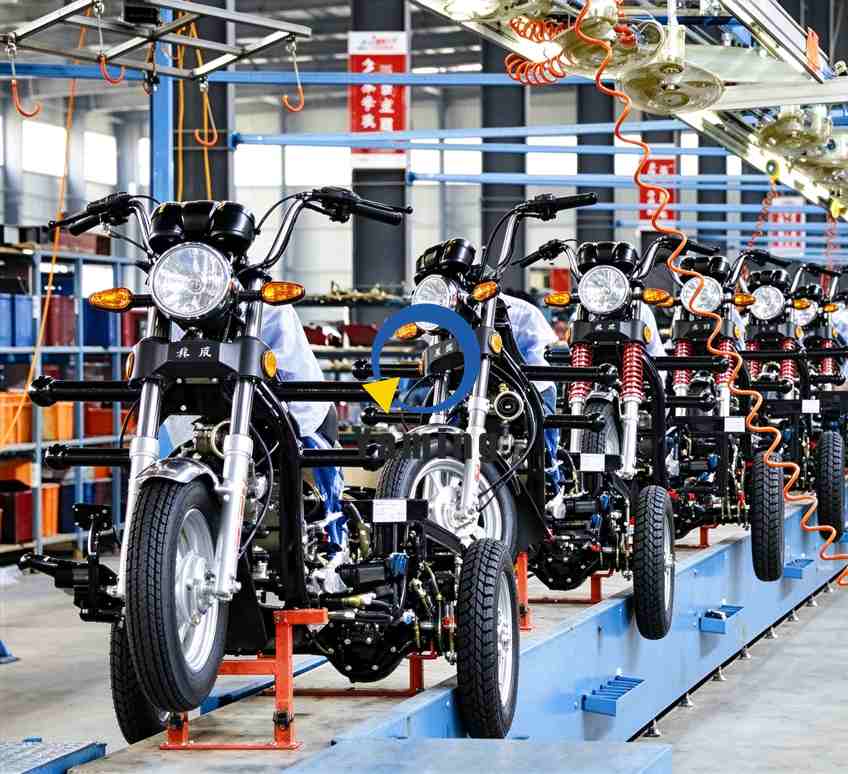
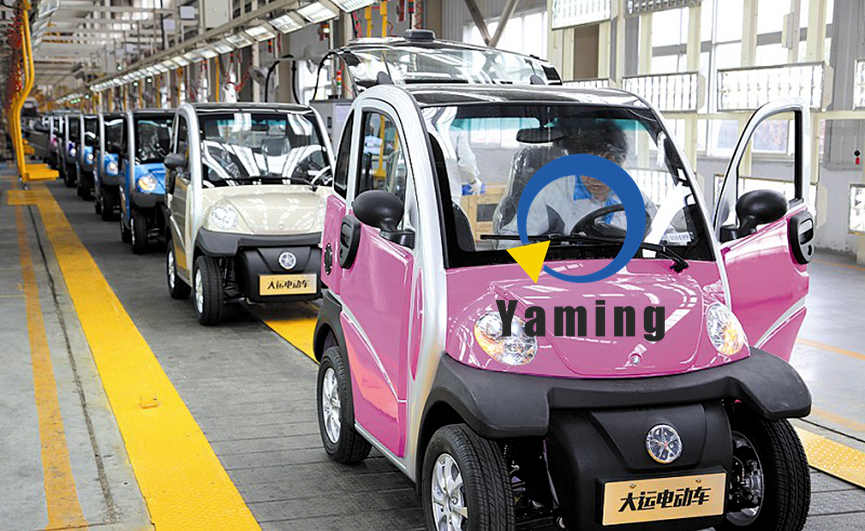
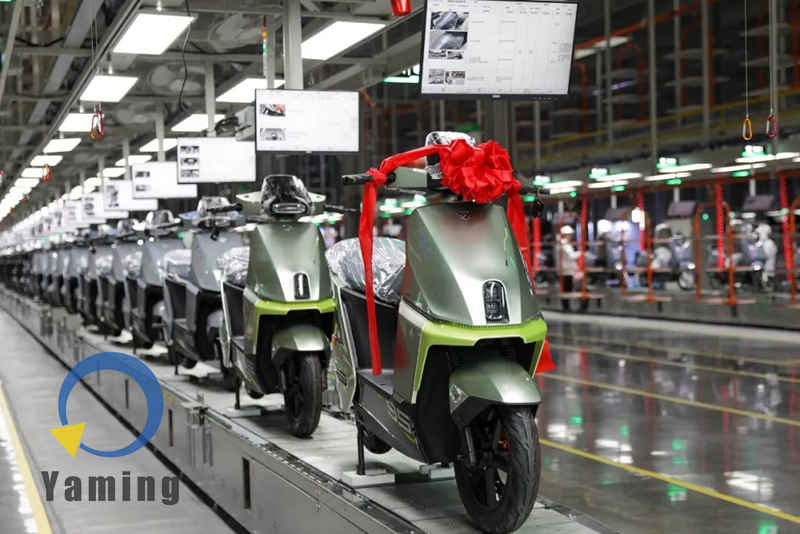
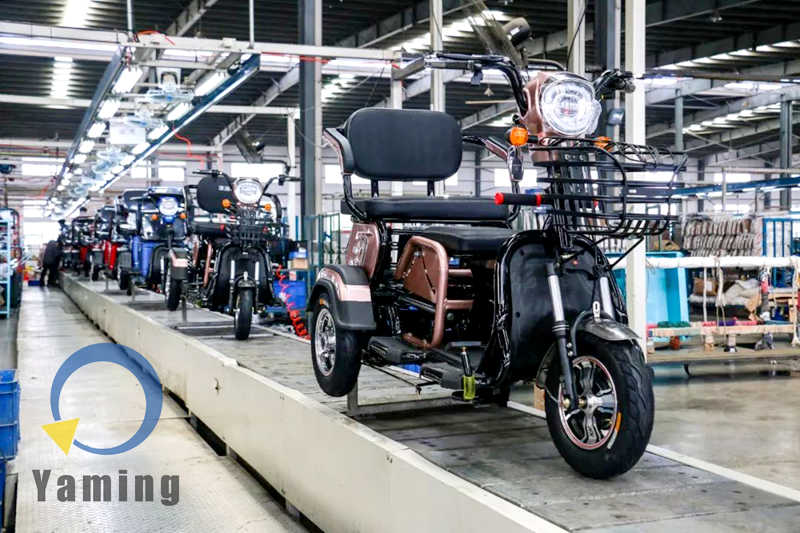
The modern tricycle final assembly line has evolved far beyond the traditional workshop model where workers simply tightened bolts around the frame. It is now an integrated modular intelligent manufacturing system combining conveying, assembly, inspection, and informatization.
A contemporary tricycle assembly line consists of four core subsystems: the conveying system, the process equipment system, the inspection system, and the control system. The conveying system, primarily based on a plate chain conveyor, carries the frame through the entire process from loading to final assembly and offloading. The process equipment system includes automatic tightening devices, vision-guided systems, pressing equipment, and more. The inspection system handles dimensional checks, performance tests, and visual inspections. The control system is centrally managed by PLC plus an MES system, enabling real-time monitoring and analysis of production data. The frame enters the plate chain line after having undergone shot blasting, rust removal, electrophoretic coating, and topcoat painting (these are pre-assembly/painting processes completed in separate workshops; the body entering the assembly line is already a finished painted frame). Then follow the installation of the engine or motor, wheels, electrical system, seat and cargo box, and finally the complete vehicle undergoes testing before rolling off the line.
In terms of production cycle time, it typically takes 3 to 8 minutes per unit, and an intelligent electric tricycle line can achieve a takt time of 5 to 10 minutes per unit, far exceeding traditional manual assembly. The automation rate of smart lines usually exceeds 70%. For manpower, a medium-scale line with an annual output of 50,000 units can be operated by fewer than 30 people. In energy consumption, fully automated lines save about 15% to 20% compared to semi-automated ones. U-shaped lines are suitable for small to medium-sized cargo tricycles (cycle time 3–5 minutes), while straight-line transport combined with AGVs is applied to heavy-duty agricultural tricycles (cycle time 8–12 minutes).
Modularity and rapid changeover capability are key technologies for handling the wide variety of tricycle types. Modular design allows flexible adjustment of workstation quantity and configuration, enabling different models to be produced via quick die changes and program switching. The switch between fuel and electric models can be completed within 30 minutes. In automatic die-change systems, the CNC bending machine changeover time is less than 3 minutes, and the riveting robot’s vision-guided positioning error is within ±0.3 mm. Different vehicle types have distinct process requirements: cargo tricycles need reinforced welding for heavy-duty cargo boxes with a weld tensile strength no less than 350 MPa; electric tricycles require quick-change mechanisms for battery packs and anti-misinsertion designs for connectors; agricultural tricycles need hydraulic lift installations with cylinder test pressure of 12 MPa ±5%.
For information traceability and precision assembly, full MES control ensures that all production data can be traced, facilitating quality management and process optimization. The critical station pass rate on high-end intelligent lines can reach over 99.5%. Precision assembly equipment includes servo presses combined with hot-pressing technology for rear axle installation, automatic brake fluid filling, pneumatic tool fastening, 3D wiring stations with robotic arms for automated harness routing, and vision-guided systems for automatic tightening and automatic inspection of assembly quality and vehicle performance.
Typical Parameters of the Final Assembly Plate Chain Conveyor
The tricycle final assembly line itself generally adopts a plate chain conveyor structure, composed of steel guide rails, steel plates, and specialized roller chains. Below are common reference configurations in the industry:
Basic Line Parameters
- Line length: Standard reference 30 meters, customizable from 30 to 100 meters according to production capacity; large lines can reach 80 meters.
- Line width: 660–710 mm, chain plate width 200 mm.
- Working height: 500 mm (±10 mm adjustable).
- Station pitch: 2–3 meters per station; frame positioning fixtures are configured at intervals of 2.2–3.2 meters along the line.
- Number of stations: 13 opposed stations (for a standard 30-meter line).
Chain Plate and Conveying System
- Chain plate dimensions: 500 mm × 200 mm × 2 mm (fixture chain plates use 3 mm thick cold-rolled steel).
- Chain type: Special single-side curved-plate roller bearing chain with 100 mm pitch; one set of guide wheels every 1000 mm.
- Chain roller diameter: 38 mm; upper rail uses 40×63×5 angle iron, lower rail uses 50×50×5 angle iron.
- Support frame: Made of 40×60×3 square steel tube, support spacing 1000 mm.
- Surface treatment: Spray painting for the line body, galvanized anti-rust treatment for chain plates.
Drive and Speed Control
- Drive: Variable-frequency motor with cycloidal pinwheel reducer (or worm gear reducer), typical power 3.7–5.5 kW.
- Line speed: 0.3–6 m/min adjustable (commonly 0.5–4 m/min), stepless variable-frequency speed regulation.
- Operation mode: Continuous running / intermittent indexing (paced) operation, selectable; cycle time set by timer relay.
Auxiliary Configurations
- Each station equipped with: 220V power socket, 6-point galvanized air pipe quick coupling, tool box, parts bin, pneumatic screwdriver hanger.
- Air supply joints on both sides of the line at each station; power sockets arranged bilaterally.
- For lines with overhead canopy: two 40W fluorescent lamps and one industrial ceiling fan per station.
- Three to four emergency stop buttons distributed at the head, middle, and tail of the line.
- Single-point load capacity: 200–500 kg, suitable for conveying heavier tricycle components.
Production Efficiency
- Average improvement of 30%–50% in assembly efficiency compared to traditional manual assembly.
- Rhythm-based production requires that the process operation time at each station be roughly equal to maximize overall line efficiency.
Key Design Logic of the Plate Chain Conveyor: The chain plates move in a continuous loop together with the chain. The tricycle frame is fixed onto dedicated traveling fixtures via its center stand. The workpiece moves along the line, and operators at each station perform their assigned assembly actions according to the takt time. Sensors cooperate with the PLC to ensure precise stopping positions, achieving paced production where either “the vehicle moves while the worker stays” or “the worker moves while the vehicle stays.”
Contact information
- If you have any questions or needs about the automated assembly line, please contact us via email: [email protected]